


18 Aug You Can Try Joe Rogan’s Red Light Therapy for Better Vision
You Can Try Joe Rogan’s Red Light Therapy for Better Vision to see how modern photobiomodulation is changing the way we approach retinal health and age-related vision decline. When podcast host Joe Rogan discusses cutting-edge wellness topics on The Joe Rogan Experience, millions of listeners tune in to hear about emerging biohacking protocols and medical technology. Recently, red light therapy—scientifically known as photobiomodulation—has gained massive attention for its ability to boost cellular energy, reduce inflammation, and enhance tissue repair. But while red light panels are often praised for skin rejuvenation and muscle recovery, many people are surprised to learn that you can try red light therapy for better vision under legitimate medical supervision.
At The Eye Professionals, we receive frequent questions from patients asking whether popular red light therapy techniques actually work for eye conditions, particularly age-related macular degeneration (AMD). The answer lies in understanding how targeted light frequencies interact with delicate retinal cells, and how specialized clinical devices elevate consumer light therapy into an evidence-based medical treatment.
The Science Behind Red Light Therapy for Better Vision and Retinal Health
When patients hear that you can try Joe Rogan’s red light therapy for better vision, they are often curious about the underlying biology. Red light therapy relies on photobiomodulation (PBM), a process where specific wavelengths of red and near-infrared light penetrate biological tissues to stimulate cellular function.
In the human eye, the retina—and specifically the macula—has one of the highest metabolic demands of any tissue in the body. Retinal cells rely heavily on tiny powerhouses called mitochondria to generate adenosine triphosphate (ATP), the primary energy currency used for cellular repair, nutrient transport, and waste clearance.
As we age, or when conditions like dry age-related macular degeneration set in, mitochondrial function degrades:
- Energy Depletion: Retinal cells struggle to produce sufficient ATP to maintain normal metabolic function.
- Oxidative Stress: Harmful free radicals accumulate, damaging light-sensing photoreceptor cells and the retinal pigment epithelium (RPE).
- Waste Accumulation: Metabolic debris forms yellowish deposits called drusen beneath the macula, leading to gradual central vision loss.
When exposed to precise red (660 nm) and near-infrared (850 nm) wavelengths, an enzyme inside mitochondria called cytochrome c oxidase absorbs the light energy. This reaction stimulates ATP synthesis, reduces oxidative stress, and helps retinal cells perform their natural repair processes more efficiently.
Why You Can Try Joe Rogan’s Red Light Therapy for Better Vision Using Clinical Technology
While consumer red light panels have become popular for home use, shining a standard commercial LED panel directly into your eyes poses significant risks and lacks clinical precision. The reason you can try red light therapy for better vision safely and effectively in an eye care setting is due to medical-grade technology designed specifically for ophthalmic treatment.
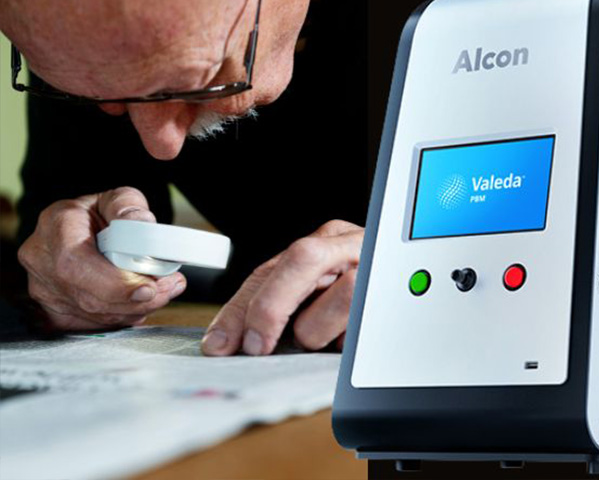
A prime example of clinical photobiomodulation technology is the Valeda Light Delivery System. Unlike general wellness light panels, the Valeda Light Delivery System is engineered specifically for eye care professionals to treat retinal conditions such as dry macular degeneration.
How the Valeda Light Delivery System Works
The Valeda Light Delivery System utilizes a proprietary combination of three distinct wavelengths, delivered in short, precise doses directly to the eye:
- Yellow Light (590 nm): Inhibits oxidative stress factors and supports cellular signaling pathways.
- Red Light (660 nm): Directly activates mitochondrial cytochrome c oxidase to boost cellular energy and ATP production.
- Near-Infrared Light (850 nm): Penetrates deeper retinal tissue layers to enhance microcirculation and lower tissue inflammation.
During a treatment session, patients sit comfortably in front of the device while light is delivered safely through the pupil. Clinical studies evaluating photobiomodulation using specialized devices like Valeda have demonstrated measurable visual improvements, including enhanced contrast sensitivity, improved visual acuity, and reductions in macular drusen volume—all without invasive surgery or uncomfortable downtime.
Understanding Macular Degeneration and Your Treatment Options
To understand why therapeutic light protocols are becoming so significant, it is helpful to look at how age-related macular degeneration affects sight. Macular degeneration is the leading cause of vision loss among Americans aged 65 and older. The disease affects the macula, the central portion of the retina responsible for the sharp vision needed for reading, driving, and recognizing faces.
Macular degeneration is classified into two primary types:
- Dry Macular Degeneration (Non-Neovascular): Accounting for roughly 85 to 90 percent of all AMD cases, dry AMD involves the thinning of macular tissues and the accumulation of drusen deposits. Over several years, dry AMD can slowly progress to late-stage geographic atrophy, leading to permanent central visual impairment.
- Wet Macular Degeneration (Neovascular): In about 10 percent of cases, abnormal blood vessels grow beneath the retina, leaking fluid or blood into the macular tissue and causing rapid, severe central vision loss.
Historically, treatment options for dry AMD were limited to lifestyle modifications, UV-blocking eyewear, and specific oral antioxidant supplements based on the Age-Related Eye Disease Studies (AREDS and AREDS2). While AREDS2 supplements help lower the risk of progressing from dry to wet AMD, they do not reverse existing cellular fatigue. This is why patients are so excited to learn that you can try red light therapy as a proactive, non-invasive method to support cellular health in dry AMD.
Comprehensive Macular Care at The Eye Professionals
At The Eye Professionals, our team of board-certified ophthalmologists and skilled optometrists is dedicated to delivering advanced, compassionate care for all retinal conditions. We evaluate each patient individually to ensure that modern therapies are integrated into a comprehensive eye health plan.
Our complete range of macular degeneration services includes:
- Advanced Retinal Diagnostic Imaging: Utilizing high-resolution Optical Coherence Tomography (OCT) scans and digital fundus photography to map retinal layers, measure drusen accumulation, and detect subtle structural changes.
- Routine Retinal Monitoring: Tracking the progression of dry AMD closely over time to safeguard your central sight.
- AREDS2 Supplement Guidance: Assisting patients in choosing evidence-based nutritional strategies tailored to their specific stage of AMD.
- Anti-VEGF Medical Therapies for Wet AMD: Providing state-of-the-art intravitreal injections (such as Lucentis, Eylea, and Avastin) to stop abnormal blood vessel leakage if dry AMD converts to the wet form.
- Innovative Non-Invasive Photobiomodulation: Evaluating individual candidacy to determine whether you can use red light therapy through safe, medical-grade photobiomodulation protocols.
What to Expect During Your Evaluation
Before starting any red light therapy or photobiomodulation treatment for your eyes, a comprehensive diagnostic consultation is necessary. Expect a thorough process designed to evaluate your total retinal health:
- Visual Acuity and Contrast Testing: Measuring fine central visual performance and contrast perception under varying light conditions.
- Detailed Retinal Mapping: Performing OCT imaging to evaluate the health of your retinal pigment epithelium and measure drusen volume.
- Mitochondrial Health Assessment: Determining if your current stage of dry AMD or visual fatigue makes you a good candidate for photobiomodulation treatments like the Valeda Light Delivery System.
- Customized Treatment Plan: Outlining a tailored care protocol that combines lifestyle adjustments, nutritional support, regular monitoring, and advanced light therapy.
Schedule Your Consultation with The Eye Professionals for Red Light Therapy for Better Vision
Biohacking trends featured on popular podcasts often point toward genuine scientific breakthroughs, but eye care requires professional diagnostic precision. Knowing that you can use red light therapy for better vision under expert medical guidance allows you to explore innovative solutions safely.
If you or a loved one are living with dry macular degeneration or want to learn more about preserving your long-term retinal health, contact our team today. Visit The Eye Professionals Contact Page to schedule your consultation at one of our convenient office locations. Our doctors are ready to help you protect, preserve, and enhance your vision using the best of modern ophthalmic care.
Sorry, the comment form is closed at this time.